
How Much Deposit Do You Actually Need to Buy in Perth in 2026?
- Ian Freeman
- Jun 4
- 4 min read

Updated: Aug 17

Most people assume you need a 20% deposit to buy a home. That's not always true — but the answer depends on your situation, and getting it wrong can cost you thousands. Here's the honest breakdown.
The Short Answer
You can buy with as little as 5% of the purchase price as a deposit. Whether that's the right move for you depends on a few things — primarily whether you qualify for a government scheme, and whether you're comfortable paying Lenders Mortgage Insurance (LMI).
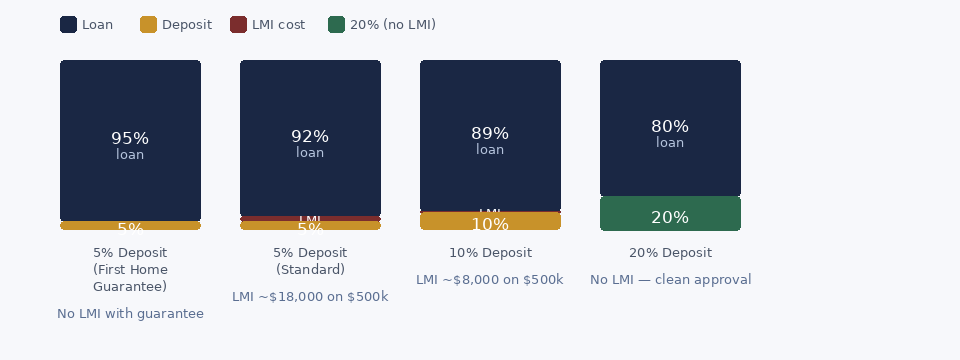
Here's what the different deposit levels actually look like:
The 20% Rule — Where It Comes From
The 20% figure isn't arbitrary. It's the point at which lenders no longer require Lenders Mortgage Insurance (LMI). When you borrow more than 80% of the property's value, the lender takes on more risk — and they pass the cost of insuring that risk on to you.
LMI protects the lender, not you. It's a one-off premium, usually added to your loan, and it can be substantial.
But 20% is not the only path. It's just the cheapest one in the long run.
The First Home Guarantee — The 5% Option That Avoids LMI
The federal government's First Home Guarantee (previously called the First Home Loan Deposit Scheme) allows eligible first home buyers to purchase with as little as a 5% deposit — without paying LMI.
The government essentially guarantees the remaining 15% to the lender, removing the need for LMI entirely.
First Home Guarantee — key eligibility criteria (2026)
Australian citizen or permanent resident
First home buyer (or haven't owned property in the last 10 years)
Income under $125,000 (singles) or $200,000 (couples)
Property under the price cap for WA (currently $700,000 for Perth metro)
Must be your principal place of residence — not an investment
Places are limited — allocated through approved lenders each financial year
If you qualify, this is one of the most powerful tools available to a first home buyer in Australia. Getting your application in early each financial year matters — places can be exhausted.
What Is Genuine Savings?
This trips up a lot of buyers who assume any money in their account counts as a deposit. It doesn't, necessarily.
Most lenders require you to demonstrate genuine savings — funds that have been held or accumulated in your account over at least three months. The idea is to show you have the financial discipline to save, not just that someone handed you money last week.
What counts as genuine savings:
Regular savings over 3+ months, shown via bank statements
Term deposits held for 3+ months
First Home Super Saver Scheme (FHSSS) withdrawals
Shares or managed funds held for 3+ months
What usually doesn't count (on its own):
A lump sum gifted by family that arrived recently
Tax refunds received last week
Inheritance received in the last 3 months
Family gifts aren't automatically disqualifying — but lenders will ask questions, and you usually need to combine them with some demonstrated savings of your own. Different lenders have different policies here, which is where having a broker in your corner helps.
The Real Cost of LMI — Should You Pay It?
LMI gets a bad reputation, but it's not always the wrong call. Sometimes paying LMI to get into the market earlier makes more financial sense than waiting years to save a larger deposit — especially in a rising market like Perth.
Here's a rough guide to what LMI costs at different deposit levels:
The question isn't just "how much is LMI?" — it's "how much would I miss out on in capital growth if I waited another two years to save the extra deposit?"
In a market where property values are rising, paying $15,000 in LMI today might be considerably cheaper than the extra growth you'd miss by waiting.
"LMI isn't a fine for not having a bigger deposit. It's the cost of getting into the market sooner — and sometimes that's worth it."
What About the First Home Owner Grant?
In Western Australia, the First Home Owner Grant (FHOG) provides $10,000 for eligible buyers purchasing or building a new home valued under $750,000. This is a grant — not a loan — and it doesn't have to be repaid.
The FHOG can contribute toward your deposit, but lenders typically want to see it combined with genuine savings rather than used as the entire deposit. It's a useful boost, not a replacement for a savings strategy.
The Deposit You Need vs the Deposit You Should Have
These are two different things, and it's worth being clear about both.
The deposit you need to get finance approved might be 5%. But the funds you actually need available on settlement day need to cover more than just the deposit:
Stamp duty — in WA, first home buyers are exempt on properties up to $430,000, with concessions up to $530,000. Above that, standard rates apply.
Settlement agent / conveyancer fees — typically $1,500–$2,500
Building and pest inspection — $400–$800
Moving costs — variable but budget $1,000–$3,000
Immediate maintenance or furnishing costs — often underestimated
As a rough rule, budget for your deposit plus an additional 3–5% for purchase costs, depending on the property price and whether stamp duty applies.
So — What's the Right Deposit for You?
There's no universal answer. The right deposit depends on your income, your savings history, whether you qualify for any government schemes, how quickly Perth property prices are moving, and how much risk you're comfortable with on your repayments.
What I can tell you is that buying with less than 20% is entirely viable and done by thousands of Australians every year. The key is understanding the trade-offs clearly before you commit.
General information only. LMI figures and grant details are indicative and subject to change. Eligibility criteria for government schemes vary. Always confirm current thresholds with your broker or the relevant government body. Credit Representative Number 439731.
Not sure how much deposit you actually need?
I can work through the numbers with you — including which government schemes you might qualify for and what lenders will actually require.


Comments