
The Complete Guide to Buying Your First Home in WA — Deposits, Government Schemes, Stamp Duty and Home Loans
- Ian Freeman
- Aug 24
- 6 min read

Updated: Aug 17

Buying your first home in WA in 2026 involves more moving parts than most people realise — deposits, stamp duty, government grants, and low-deposit lending schemes all interact with each other, and getting the order of operations right can be worth tens of thousands of dollars. This guide walks through every piece.
Start here: how much deposit do you actually need?
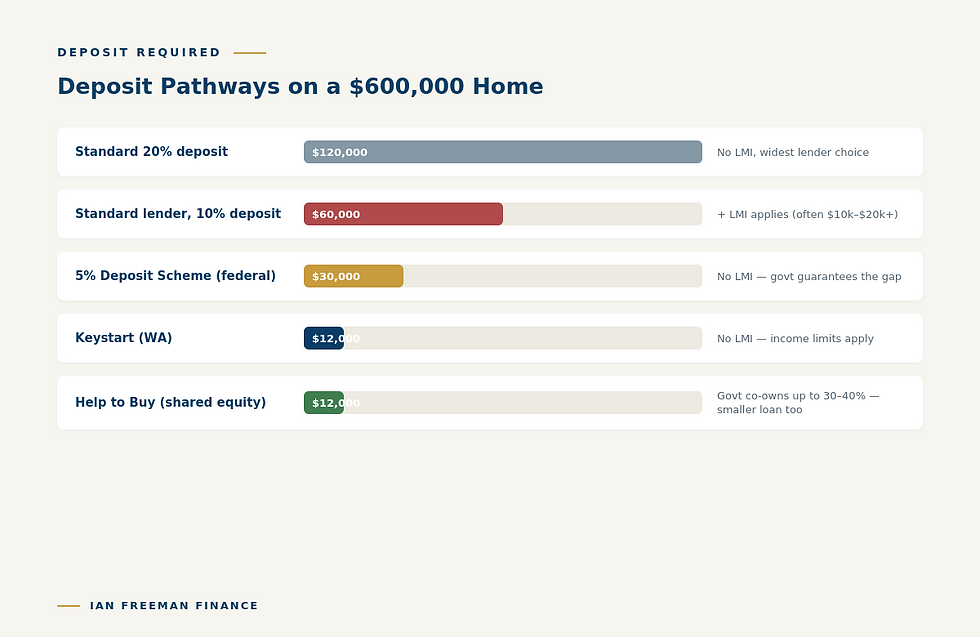
The honest answer is: it depends which pathway you use, and the differences are large. A traditional 20% deposit on an $600,000 home is $120,000. But most first home buyers in WA don't need anywhere near that, once government schemes are factored in.
20% deposit, standard lender: no LMI, widest choice of lenders, but the slowest to save for.
5–19% deposit, standard lender: LMI applies (often $10,000–$30,000+ depending on loan size), unless a government scheme covers it.
5% deposit via the Australian Government's 5% Deposit Scheme: no LMI, government guarantees the gap to 20%.
2% deposit via Keystart: WA's state-owned lender, no LMI, designed specifically for buyers who can service a loan but can't save a large deposit.
2% deposit via Help to Buy: a federal shared equity scheme — the government co-owns part of your home in exchange for a smaller loan and smaller repayments.
The Australian Government 5% Deposit Scheme
This scheme (formerly known as the First Home Guarantee) lets eligible first home buyers purchase with as little as a 5% deposit, with the government guaranteeing up to 15% of the property value so no Lenders Mortgage Insurance is payable. It was significantly expanded from 1 October 2025: there are no longer any income caps or annual place limits for most applicants, making it far more accessible than the earlier version of the scheme.
For Western Australia specifically, the property price caps are:
Area | Price cap |
Perth metro | $850,000 |
Regional WA | $600,000 |
On an $800,000 home, a 5% deposit is $40,000 — compared to $160,000 for a traditional 20% deposit — plus you avoid LMI entirely, which alone can be worth tens of thousands of dollars on a high-LVR loan.
Keystart — WA's own low-deposit lender
Keystart is a Western Australian Government-owned lender, established in 1989 specifically to help West Australians who can service a mortgage but struggle to save a large deposit. It's a genuinely WA-specific option most interstate guides won't mention.
Deposit from as little as 2%, with no LMI payable.
Current income limits: around $155,000 for singles, $228,000 for couples and families (Perth metro; regional limits differ).
Current Perth metro property price cap: around $860,000.
Extra repayments are allowed at any time with no penalty — most Keystart borrowers plan to refinance to a mainstream lender once they've built enough equity, since Keystart is designed as a transitional product, not necessarily a lifetime one.
Income and price limits for both the federal scheme and Keystart are reviewed and adjusted periodically — always confirm the current figures before relying on them for a purchase decision.
Help to Buy — the federal shared equity scheme
Help to Buy works completely differently to the other options above, and it's worth understanding the distinction clearly. Rather than helping you borrow more with a smaller deposit, the government actually co-owns part of your home alongside you — contributing up to 40% of the purchase price for a new build, or 30% for an established home, as an equity share. In exchange, you need only a 2% deposit, and your loan (and repayments) are correspondingly smaller, since you're only borrowing your share of the property's value.
Help to Buy launched nationally on 5 December 2025, and Western Australia passed its own enabling legislation to join the scheme shortly after. Key details for WA:
Property price caps: $850,000 for Perth, $600,000 for the rest of WA.
Income caps: around $103,000 for individual applicants, $165,000 for joint applicants or single parents (based on your most recent Notice of Assessment).
Deposit: as little as 2% of the purchase price.
Owner-occupier only — you must live in the property, can't rent it out, and can't own any other property in Australia or overseas at the time you apply.
Places are limited — around 10,000 places nationally per year (40,000 over four years), so it isn't guaranteed to be available whenever you're ready to buy.
A worked example: on an $800,000 new home, a 40% government equity contribution is $320,000 — meaning you'd only need to borrow (and pay interest on) roughly $460,800 after your 2% deposit, rather than borrowing close to the full purchase price. That's a genuinely significant reduction in both your deposit hurdle and your ongoing repayments.
The trade-off is what happens later: when you sell, refinance, or choose to buy back the government's share, that share is calculated at the then-current market value, not the original dollar amount. If your home has grown in value, buying back or settling the government's share costs more in dollar terms than what they originally contributed — you're sharing the capital growth on their portion, not just repaying a loan. This is the central thing to weigh up against the smaller repayments: less growth stays in your pocket while the government remains a co-owner.
Worth knowing: currently only two lenders participate in Help to Buy — Commonwealth Bank and Bank Australia — and at present, only Bank Australia is accessible through the mortgage broker channel. More lenders are expected to join through 2026, which may open up more options over time.
Stamp duty (transfer duty) in WA
Following the 2026–27 WA State Budget, stamp duty concessions for first home buyers were substantially increased from 7 May 2026:
Property type | Full exemption up to | Concessional rate up to |
New or established home | $600,000 | $800,000 |
Vacant land | $450,000 | $550,000 |
The WA Government estimates these changes can save eligible buyers up to $22,515 on a home purchase, or up to $25,390 for those buying land and building.
First Home Owner Grant (FHOG)
The FHOG is a one-off $10,000 payment for eligible first home buyers — but it's easy to get wrong: it only applies to new homes (newly built, off-the-plan, or a home you're building yourself), not established properties. This catches out a surprising number of buyers who assume it applies to any first purchase.
The property value cap for the FHOG was also raised in the 2026–27 Budget, from $750,000 to $800,000 — meaning more house-and-land packages and new builds now qualify than before.
Home Buyer Assistance Account (HBAA)
A smaller, lesser-known WA grant worth knowing about: the HBAA provides up to $2,000 toward incidental costs like conveyancing, inspections, and other settlement fees, for first home buyers purchasing an established or partially built home valued at $400,000 or less through a licensed real estate agent. The application must be lodged within 90 days of your contract, via your lender.
Stacking the schemes together
Stamp duty concessions and the FHOG apply regardless of which deposit pathway you use, so most first home buyers in WA end up combining one deposit-side scheme with both of those. A common combination for a new-build purchase might look like:
5% deposit via the Australian Government 5% Deposit Scheme, or 2% via Keystart, or 2% via Help to Buy (choose one — these are alternative ways of structuring your deposit and loan, not stackable with each other)
$0 stamp duty (if under the $600,000 exemption threshold)
$10,000 FHOG (new build only)
Up to $2,000 HBAA (established/partially built home under $400,000 — not stackable with a new-build FHOG claim on the same property in most cases, since the property types differ)
The right deposit-side pathway depends heavily on your goals: the 5% Deposit Scheme and Keystart both leave you as sole owner with a larger loan; Help to Buy gives you smaller repayments today in exchange for sharing future growth with the government. Which combination actually works for you depends on whether you're buying established or new, your income, your deposit, and the specific property price — which is exactly the kind of thing worth mapping out properly before you start looking, not after you've found "the one."
Not sure which schemes you actually qualify for?
This article is general information only and does not take into account your personal financial situation, needs, or objectives. It is not financial, tax, or legal advice. Grant amounts, income limits, price caps, and stamp duty thresholds referenced above are current as at time of writing and are reviewed periodically by the WA Government, Keystart, and Housing Australia — always confirm current figures before making a purchase decision. Please seek independent financial advice before making decisions about your home loan. Ian Freeman is a Credit Representative (Credit Representative Number 439731) of Finsure Finance & Insurance Pty Ltd, Australian Credit Licence 384704.


Comments