
What Is Lenders Mortgage Insurance — and Is It Always a Bad Thing?

Updated: Aug 17
Lenders Mortgage Insurance gets talked about like it's a punishment for not saving enough. It's not. It's a cost — sometimes a worthwhile one. Here's what it actually is, what it costs, and when paying it might make sense.
What LMI Actually Is
Lenders Mortgage Insurance (LMI) is an insurance policy that protects the lender — not you — if you default on your home loan and the sale of the property doesn't cover the outstanding debt.
Read that again: it protects the lender, not you.
You pay the premium. The lender is the beneficiary. If you default and there's a shortfall after the property is sold, the insurer pays the lender — and then pursues you for that amount.
This is important to understand because LMI doesn't provide you with any protection or coverage. It simply allows the lender to take on the additional risk of lending above 80% of the property's value.
When Does LMI Apply?
LMI applies when your Loan to Value Ratio (LVR) is above 80% — meaning you're borrowing more than 80% of what the lender values the property at.
A few things worth knowing:
LMI is calculated on the lender's valuation, not the purchase price. If you pay $600,000 but the lender values it at $580,000, your LVR is calculated on $580,000.
LMI is typically a one-off premium paid at settlement — either upfront in cash or capitalised into your loan (added to your loan balance).
If you capitalise it, you pay interest on the LMI amount for the life of the loan. The real cost is therefore higher than the headline premium.
Not all lenders use the same LMI insurer, and premiums vary. This is one reason the cheapest interest rate isn't always the cheapest loan overall.
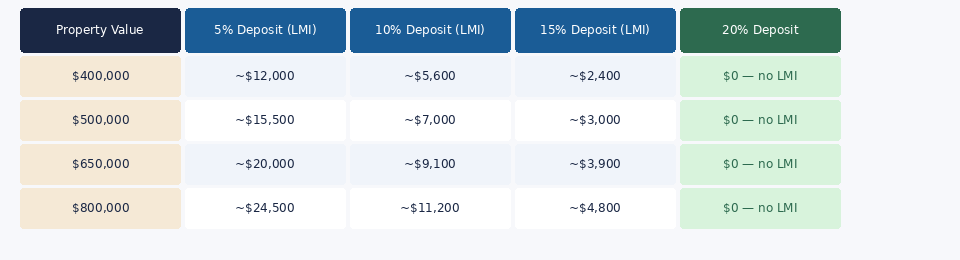
How Much Does LMI Cost?
LMI premiums are calculated as a percentage of the loan amount, and they increase as your LVR increases. The jump from 90% to 95% LVR is particularly sharp.
These numbers are approximate — actual premiums depend on the lender, the LMI provider they use, your loan type, and whether you're buying as an owner-occupier or investor.
The "Is LMI Bad?" Question
This is where most of the advice gets overly simplistic. LMI isn't inherently bad. It's a cost — and whether it's worth paying depends entirely on your circumstances.
Here's the question that actually matters: what would you gain or lose by waiting longer to save a larger deposit?
Example: Perth property at $600,000
You have a 10% deposit ($60,000). LMI on this purchase: approximately $8,400.
To avoid LMI, you need to save another $60,000 — which takes you 18 months at your current savings rate.
If Perth property values grow at 5% per year during that 18 months, the same home now costs approximately $645,000 — an increase of $45,000.
You saved $8,400 in LMI. You missed out on $45,000 in potential growth.
This doesn't mean LMI is always worth paying. In a flat or falling market, waiting makes more sense. In a rising market like Perth has experienced, it's often worth running the numbers before assuming you should wait.
"The cost of LMI is known and fixed. The cost of waiting is uncertain — but in a rising market, it's often much higher."
When LMI Is Worth Paying
When property values in your target area are rising and you'd miss meaningful growth by waiting
When rent costs are making it difficult to save a larger deposit quickly
When you have stable income and can comfortably service the loan — the slightly higher repayment from capitalised LMI isn't a strain
When you're close to 80% LVR and a small additional contribution could eliminate or significantly reduce the premium
When LMI Is Worth Avoiding
When property prices are flat or declining
When you're close to 80% LVR and a small additional effort gets you there
When you qualify for the First Home Guarantee and can avoid LMI with a 5% deposit anyway
When you're already stretching your budget and don't need the additional loan balance
LMI vs the First Home Guarantee
If you're a first home buyer, the First Home Guarantee is worth understanding before you assume LMI is unavoidable. Under this scheme, eligible buyers can purchase with 5% deposit and the government guarantees the remaining 15% to the lender — meaning no LMI is required.
The catch: places are limited, income caps apply, and the property must be under the relevant price threshold (currently $700,000 for Perth metro). But if you qualify, it's essentially free LMI elimination.
LMI Is Not the Same as Mortgage Protection Insurance
Just to be clear about a common confusion: LMI and mortgage protection insurance (sometimes called mortgage repayment insurance) are entirely different products.
LMI protects the lender. Mortgage protection insurance protects you — it covers your repayments if you lose your job, become seriously ill, or die. It's an optional product you arrange separately.
If you're borrowing at high LVR, it's worth thinking about both — but they serve completely different purposes.
General information only. LMI premiums and eligibility criteria vary by lender and insurer. Market growth projections are illustrative only and cannot be relied upon. This article does not constitute financial advice. Credit Representative Number 439731.
Wondering whether LMI is worth it in your situation?
I can run through the actual numbers for your deposit, your target area and your savings timeline — so you can make an informed call rather than a guess.