
The First Home Buyer's Timeline: What Happens Between Pre-Approval and Settlement?

Updated: Aug 17

One of the most common things I hear from first home buyers is that they didn't really understand what was happening at each stage of the process — or what they were supposed to be doing next. This article fixes that.
The Six Stages — At a Glance
Stage 1: Get Your Finances Ready
Before you speak to a lender or submit anything formal, there's groundwork to do. This is the stage most buyers rush past — and where a lot of preventable problems start.
What to sort out first:
Your credit file. Check it via Equifax or Illion before a lender does. Errors happen, and you want time to fix them.
Your genuine savings. Most lenders want to see at least 3 months of saved funds. Start accumulating — and don't make large unexplained withdrawals during this period.
Your liabilities. Credit cards, HECS debt, buy-now-pay-later accounts, car loans. Lenders assess your repayment capacity based on these, even if you pay credit cards in full each month.
Your income documents. Two recent payslips, last two years of tax returns if self-employed, group certificates. Get these organised early.
This stage typically takes 4–8 weeks if you're starting from scratch. Less if you're already organised.
Stage 2: Pre-Approval
Pre-approval (also called conditional approval or approval in principle) is a lender's assessment that you're eligible to borrow up to a certain amount — subject to finding a suitable property and final checks.
It's not a guarantee. But it's an important step because it:
Tells you what your realistic budget is
Shows sellers and agents you're a serious buyer
Speeds up formal approval once you find a property
Identifies any issues with your application before you're under time pressure
Important: pre-approval isn't unconditional approval
Don't sign a contract to purchase without understanding what conditions remain on your pre-approval. Property valuation, employment verification and final credit checks all happen after you make an offer. If the valuation comes in short, you may need to renegotiate or find additional funds.
Pre-approval typically lasts 90 days. If your property search runs longer, you may need to renew it.
Stage 3: Property Search
This is the stage that takes the most variable amount of time — anywhere from a few weeks to many months depending on the market and your criteria.
A few things buyers often don't realise during this stage:
Cooling-off periods apply in WA. You generally have 3 business days after signing a contract to withdraw, subject to a 0.25% forfeiture fee. Understanding this before you sign is important.
Finance clauses matter. Always include a finance condition in your offer that gives you time to get formal approval. Don't sign unconditional unless your finance is genuinely unconditional.
Building inspections are worth every cent. $400–$800 for a professional inspection can save you from a very expensive surprise after settlement.
Stage 4: Formal Approval
Once your offer is accepted and signed, the clock starts on your finance clause. This is typically 14–21 days in WA, though it can be negotiated.
During this period, the lender will:
Order a formal property valuation
Complete their full credit assessment
Verify your employment (sometimes via a call to your employer)
Issue formal loan documents for you to sign
This is where you need to be responsive. If your broker or lender asks for additional documents, provide them quickly. Delays in this stage can put your finance clause deadline at risk.
"The period between offer accepted and formal approval is the most stressful part of the process for most buyers. Clear communication and quick responses make it significantly smoother."
Stage 5: Settlement Preparation
Once formal approval is in hand, your settlement agent (conveyancer) takes the lead on coordinating the transfer of ownership.
This stage typically takes 4–6 weeks and involves:
Title searches and checks on the property
Calculation of adjustments (rates, water, strata fees) between you and the seller
Arranging building insurance — most lenders require this from the date contracts are signed, not from settlement
Final inspection of the property (typically 5 business days before settlement)
Transfer of your deposit and settlement funds to the settlement agent
This is also when you need to arrange your utilities connections, change of address notifications, and removalist bookings.
Stage 6: Settlement Day
Settlement is the legal transfer of ownership from the seller to you. In WA, this now happens electronically through PEXA in most cases — meaning there's no physical exchange of paperwork on the day.
Settlement usually happens between 12pm and 2pm. Once it's confirmed:
Your settlement agent notifies the real estate agent
The agent releases the keys to you
You're a homeowner
Your first mortgage repayment typically falls 30 days after settlement, though this depends on your lender and loan structure.
How Long Does the Whole Process Take?
From starting your finance conversations to getting the keys, most buyers should expect 3–6 months. Here's a rough breakdown:
Stage | Typical Duration |
|---|---|
Finance preparation | 2–6 weeks |
Pre-approval | 3–7 business days |
Property search | 4 weeks to 6+ months |
Formal approval | 1–2 weeks |
Settlement preparation | 4–6 weeks |
Total (typical) | 3–6 months |
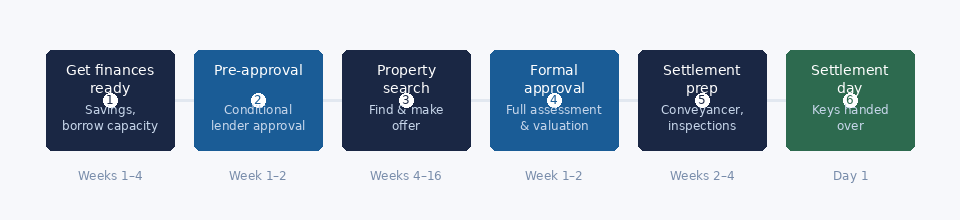
The biggest variable is the property search. Some buyers find a property in two weeks. Others take six months. Getting your finance sorted early means you're ready to move when the right property comes up — rather than scrambling to get approved under pressure.
General information only. Timelines vary by lender, property type and individual circumstances. WA-specific rules apply. Always seek professional legal and financial advice before making property purchasing decisions. Credit Representative Number 439731.
Ready to start the process?
The earlier you get your finance sorted, the better positioned you'll be when you find the right property. Let's start with a free strategy call.