
Self-Employed? Why the Timing of Your Tax Return Matters Before You Borrow


If you're self-employed, your tax returns are your payslips as far as a lender is concerned. Most business owners leave lodgement to their accountant and don't think about it again until the next tax time. But if you're planning to buy, build or refinance in the next 12 months, the timing of your 2025-26 return can make a real difference to how much you can borrow.
The deadline that's coming up
The ATO's usual deadline for lodging your own individual tax return is 31 October. If you use a registered tax agent, most agents have a lodgement program that lets them lodge later, often well into the following year. If you're new to an agent or changing agents, the ATO says to contact them before 31 October to be part of their program.
That later deadline is useful for managing tax, but it can work against you if you need a loan.
How lenders assess self-employed income
Policies vary from lender to lender, but for a standard (full documentation) loan, most lenders want:
Your last two years of personal tax returns and Notices of Assessment
Your last two years of business tax returns and financial statements, if you trade through a company or trust
An ABN that has been registered for at least two years, although some lenders accept one year
Many lenders average the two most recent years of income. Some will use the latest year on its own if income has gone up, and most will use the lower year if income has dropped. Lenders also commonly add back some non-cash or one-off expenses, such as depreciation.
Why the timing of lodgement matters
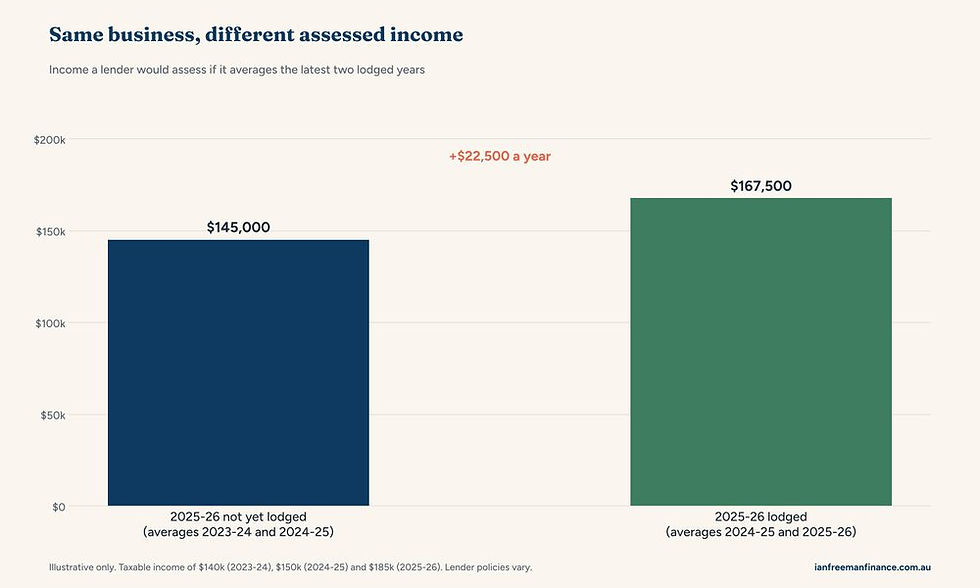
A lender can only use years you've actually lodged. If your 2025-26 return won't be lodged until next May, a lender assessing you today will look at 2023-24 and 2024-25 instead. That's fine if your income has been steady. If your business has grown, it means your best year is being left out.
Financial year | Taxable income (example) |
2023-24 | $140,000 |
2024-25 | $150,000 |
2025-26 | $185,000 |
Illustrative figures only.
If a lender averages the latest two lodged years:
Without 2025-26 lodged: it averages 2023-24 and 2024-25, giving $145,000.
With 2025-26 lodged: it averages 2024-25 and 2025-26, giving $167,500.
That's $22,500 a year, or about 15.5% more assessed income, from the same business. It can be the difference between getting the loan you need and falling short.
Same business, same income. Lodging the latest return can lift your assessed income by thousands.
When lodging early might not help
If your 2025-26 income was lower than previous years, lodging early won't improve your position, and a lender will generally assess you on the lower figure once it's lodged. Lenders also ask about current trading, so the aim isn't to hide anything. It's to make sure your application reflects your business accurately.
Either way, the right answer comes from your accountant and your broker working from the same numbers. A five-minute conversation before you lodge can save months later.
Other things worth sorting before you apply
Tax debts: an ATO debt or payment plan doesn't automatically stop you borrowing, but it needs to be disclosed and planned for. My post on ATO debts and alt doc loans covers this.
BAS lodgements: keep them up to date. Some lenders use them to confirm current trading.
Business and personal accounts: keep them separate. It makes your income much easier for a lender to follow.
Large one-off expenses: let your broker know about them. They can sometimes be added back.
Can't wait for your return?
If your latest return isn't ready, alternative documentation (alt doc) loans can assess you on BAS statements, business bank statements or an accountant's letter. They usually cost more than a standard loan, but they can bridge the gap until you can refinance.
Planning to borrow in the next 12 months?
I'll look at your last two years with you, talk to your accountant if helpful, and work out whether lodging your 2025-26 return sooner would help your application.
Sources: Australian Taxation Office, Lodge your tax return with a registered tax agent; Lender self-employed documentation requirements, summarised in general terms; Worked example calculated by Finance 365
This article is general information only and does not take into account your objectives, financial situation or needs. Scheme rules, lender policies and eligibility criteria change, so confirm the current position before acting. Lending criteria, fees and charges apply.
Ian Freeman, Finance 365. Credit Representative Number 439731 of Australian Credit Licence 384704.