
Your rate is going up this month. Do this 15-minute check first

Most major lenders have passed on the RBA's November rise in full, and the new rates start this month. Before your next repayment goes up, it's worth 15 minutes to check whether you're paying more than you need to. Here's how.
When your new rate starts
Every lender that has announced a change so far is passing on the full 0.25%. The date the higher rate applies depends on your lender:
Lender | New variable rate applies from |
BOQ, ME, Virgin Money | 7 November |
Bendigo Bank, Great Southern Bank | 11 November |
ANZ, CommBank, NAB, Westpac, Bankwest, St.George | 13 November |
Macquarie Bank | 19 November |
As announced at 9 November 2026. Your lender will write to you with your new repayment.
Your repayment usually changes from the first repayment after that date. On a $500,000 loan, the rise adds roughly $80 a month.
Step 1: Find your actual rate (2 minutes)
Log in to your banking app or check your latest statement. You're looking for the interest rate on your loan, not the lender's advertised rate. They're often different.
Lenders tend to keep their sharpest rates for new customers. Borrowers who've had the same loan for several years can end up paying noticeably more than someone walking in the door today, even with the same lender. The ACCC has highlighted this gap in its past reviews of home loan pricing.
Step 2: Compare it with what new customers get (5 minutes)
Look at the rates lenders are offering new borrowers for a loan like yours: the same loan purpose (living in or investing), repayment type and roughly the same loan-to-value ratio. If the gap is 0.25% or more, it's worth acting on.
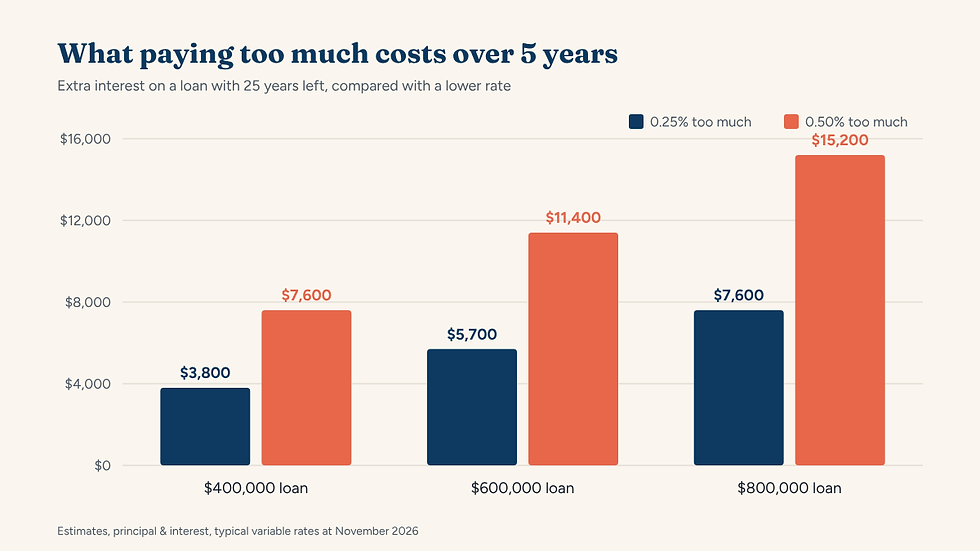
Here's what a gap costs over five years on a loan with 25 years left to run:
Loan balance | Paying 0.25% too much | Paying 0.50% too much |
$400,000 | about $63/month · $3,800 over 5 years | about $126/month · $7,600 over 5 years |
$600,000 | about $94/month · $5,700 over 5 years | about $190/month · $11,400 over 5 years |
$800,000 | about $126/month · $7,600 over 5 years | about $253/month · $15,200 over 5 years |
Estimates only, principal and interest repayments, based on typical variable rates at the time of writing.
Step 3: Ask your lender (5 minutes)
Call your lender's retention or discharge team, not the general enquiries line. Keep it simple:
Tell them your current rate and the rate you've seen offered to new customers for a similar loan.
Say you're reviewing your options, including refinancing.
Ask what they can do to keep you.
Lenders often have room to move for good existing customers, especially those with a solid repayment history and some equity. If they offer a reduction, ask them to confirm it in writing and check it on your next statement.
You can't control the cash rate. You can control whether you're paying more than you need to on top of it.
Step 4: Decide whether refinancing is worth it (3 minutes)
If your lender won't move, or won't move enough, refinancing may make sense. Weigh the saving against the costs:
Costs to leave: your current lender's discharge fee and government registration fees, usually a few hundred dollars in total.
Costs to join: some lenders charge application, legal or settlement fees. Many charge none, or offer to cover some costs for new customers.
Watch for: break costs if any part of your loan is fixed, and lenders mortgage insurance if you'd be borrowing more than 80% of your property's value.
Don't reset the clock by accident: if you refinance to a new 30-year term, your repayment drops but you pay more interest overall. Keeping your repayments the same as now gets the most from a lower rate.
As a rough guide, if the saving pays back your switching costs within a year or so, refinancing is usually worth a closer look.
One thing to check first
After five rate rises this year, some borrowers find a new lender won't approve them, because lenders test your repayments at a higher rate than you'll actually pay. If your income or expenses have changed since you took out your loan, it's worth getting your borrowing power checked before you apply anywhere, so a declined application doesn't sit on your credit file.
Want someone to run the numbers for you?
I'll compare your current rate against around 30 lenders, tell you whether it's worth asking your lender or switching, and work out what it would cost. Plain English, no obligation.
Call Ian on 0439 365 365 or take the free Home Loan Readiness Check.
This article is general information only and doesn't take into account your objectives, financial situation or needs. Consider whether it's appropriate for you and seek advice before acting. Information is current as at 9 November 2026.
Credit Representative Number 439731 of Australian Credit Licence 384704.